
Table of Contents
ToggleINTRODUCTION
When I first started researching small businesses in the USA, one mistake I kept seeing everywhere was this: people were obsessed with startup costs, but almost nobody talked honestly about the monthly cost of running a small business in the USA.
From my experience studying hundreds of real businesses—online, service-based, and local—this is where most people get surprised. You might register a business cheaply, but if you don’t understand the monthly running cost, you’ll feel pressure every single month.
So in this blog, I’ll break down the realistic monthly cost of running a small business in the USA, with practical examples, expense ranges, and clear explanations—so by the end, you’ll know exactly what to expect and whether your budget truly makes sense.
Average Monthly Cost of Running a Small Business in the USA
The monthly cost depends heavily on:
Business type (online vs physical)
Location (state & city)
Number of employees
Marketing strategy
On average, most small businesses in the USA spend anywhere between:
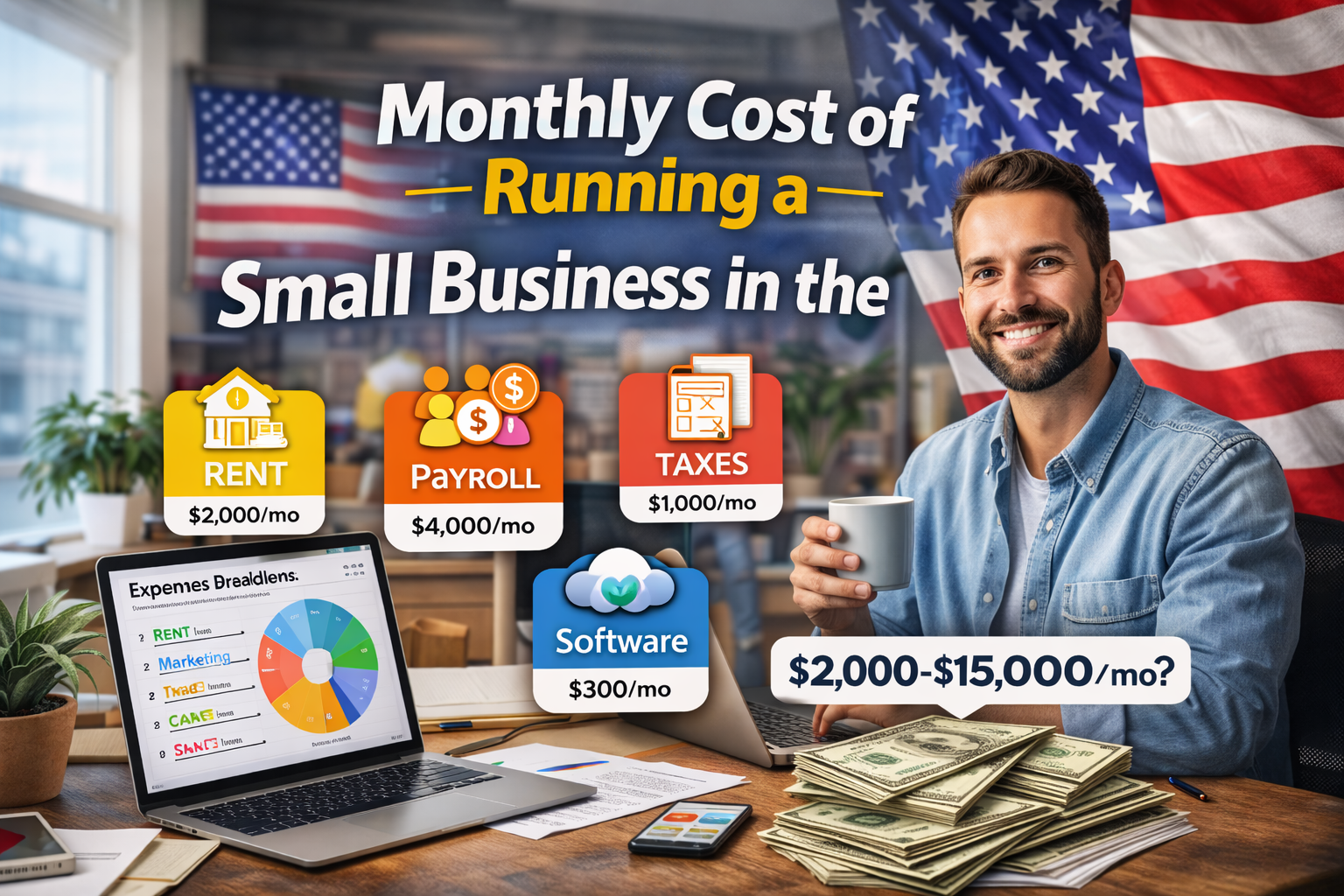
$2,000 to $15,000+ per month
But let’s break this down properly.
1. Rent & Workspace Costs

This is often the largest monthly expense for physical businesses.
Common scenarios:
Home-based business: $0–$300 (utilities portion)
Co-working space: $200–$600
Small office: $800–$2,500
Retail store: $1,500–$6,000+
Urban areas like New York or California are more expensive, while smaller states can be much cheaper.
👉 Tip: Many successful businesses start home-based to keep monthly costs low.
2. Employee & Labor Costs

If you have staff, this will be a major recurring cost.
Monthly labor expenses include:
Salaries or hourly wages
Freelancers or contractors
Payroll taxes
Employee benefits (if offered)
Average monthly estimates:
One full-time employee: $3,000–$5,000
Part-time employee: $1,200–$2,500
Freelancer (remote): $500–$2,000
Remote workers can significantly reduce costs.
3. Software, Tools & Subscriptions

Almost every modern business runs on software.
Common tools:
Accounting software
CRM systems
Email marketing tools
Design & productivity tools
AI or automation tools
Monthly cost range:
$50–$400 per month
You can start lean and upgrade as revenue grows.
4. Website, Hosting & Technology Costs

For online presence, this is unavoidable.
Monthly expenses may include:
Website hosting
Domain (averaged monthly)
Security & backups
Website maintenance
Premium plugins or SaaS tools
Typical cost:
$20–$150 per month
Cheap hosting can hurt performance, so balance cost with quality.
5. Marketing & Advertising Costs

This is where growth happens—and where many businesses overspend.
Monthly marketing options:
Google Ads
Facebook & Instagram Ads
SEO & content marketing
Influencer promotions
Email campaigns
Monthly budget ranges:
Low-budget: $200–$500
Moderate growth: $1,000–$3,000
Aggressive scaling: $5,000+
👉 Organic SEO takes time but lowers long-term costs.
6. Inventory, Supplies & Operations

This varies by business type.
Examples:
Product inventory restocking
Packaging materials
Shipping & logistics
Office supplies
Equipment leasing
Monthly range:
$300–$5,000+
Service-based and online businesses often spend much less here.
7. Utilities & Communication Costs

Often underestimated but unavoidable.
Includes:
Internet
Phone plans
Electricity
Water (for physical locations)
Monthly cost:
$150–$500
8. Insurance, Licenses & Compliance

These costs protect your business and keep it legal.
Monthly averages:
Business insurance: $40–$150
Licenses & permits (averaged): $10–$50
Accounting/bookkeeping services: $100–$300
Even if billed yearly, it’s smart to calculate them monthly.
9. Taxes & Government-Related Costs

Taxes vary by state and business structure.
Common tax-related expenses:
Estimated quarterly taxes
Payroll taxes
Sales tax management tools
👉 Always keep a buffer. Monthly tax planning is smarter than last-minute panic.
10. Emergency & Miscellaneous Costs

This is what most blogs forget.
Examples:
Unexpected repairs
Refunds & chargebacks
Software upgrades
Late fees or penalties
Recommended buffer:
$100–$500 per month
This single habit saves businesses from stress.
Monthly Cost Summary Table
| Business Type | Estimated Monthly Cost |
|---|---|
| Online / Home-based | $500 – $2,500 |
| Service-based | $1,500 – $5,000 |
| Small Office Business | $3,000 – $10,000 |
| Retail Store | $5,000 – $15,000+ |
How to Reduce Monthly Business Costs
Some practical tips:
Start home-based if possible
Use free or freemium tools
Outsource instead of hiring early
Focus on organic marketing first
Track expenses monthly
Small savings every month add up fast.
FAQs
1. What is the average monthly cost of running a small business in the USA?
Most small businesses spend between $2,000 and $15,000 per month, depending on size and type.
2. Can I run a small business under $1,000 per month?
Yes, especially online or home-based businesses with no employees and minimal marketing spend.
3. Are online businesses cheaper to run monthly?
Generally yes. Online businesses avoid rent, utilities, and inventory costs.
4. What is the biggest monthly expense for small businesses?
Rent and employee salaries are usually the largest monthly costs.
5. Should I keep emergency funds for monthly expenses?
Absolutely. A monthly buffer prevents financial stress and business disruption.
Conclusion
Running a small business in the USA is not cheap—but it is manageable if you understand your monthly costs upfront. The biggest mistake is underestimating recurring expenses and overestimating early revenue.
If you plan smart, keep costs lean, and grow step by step, your business can stay profitable and stress-free. Monthly awareness is not optional—it’s survival.