
Manus AI vs OpenClaw: Which AI Agent Should You Choose?
Manus AI vs OpenClaw: Discover the ultimate showdown between cloud browser automation and private local AI agents to choose the perfect automated workflow.
AI TOOLS
6/18/20265 min read
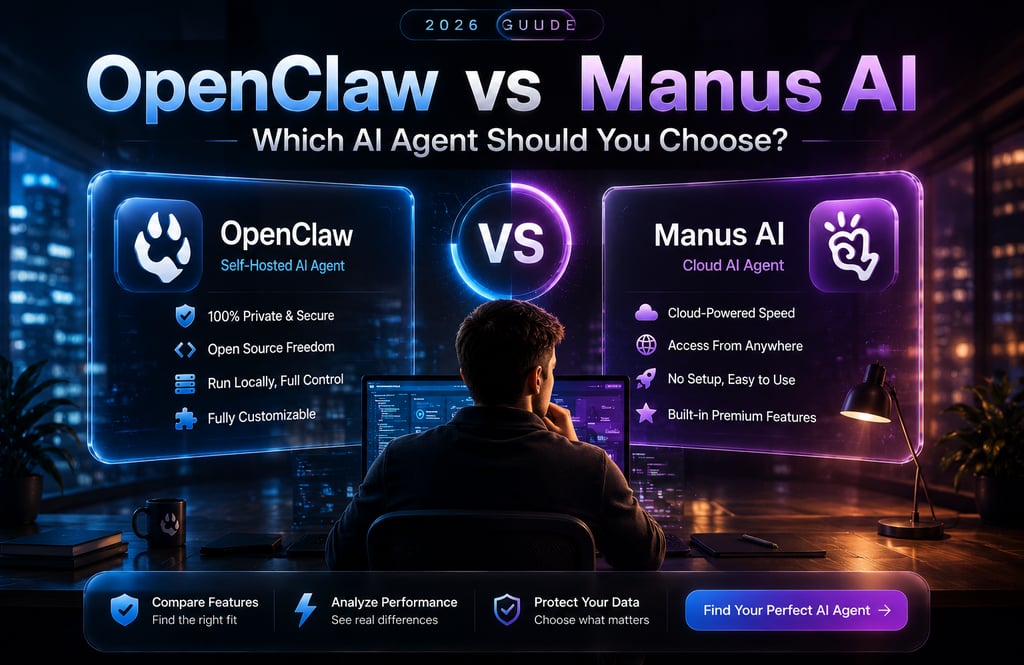
The artificial intelligence sector shifted dramatically this year. The industry is moving past standard text-generation chatbots and entering the era of autonomous AI agents—software capable of controlling web browsers, executing terminal commands, scraping data, and handling multi-step workflows independently.
Why are so many people comparing Manus AI and OpenClaw right now? As AI agents become more capable of performing real-world tasks, users are increasingly looking for tools that can automate research, browser actions, content creation, coding workflows, and business operations. Manus AI and OpenClaw represent two very different approaches to achieving these goals. Understanding their strengths, limitations, costs, and ideal use cases can help you choose the right platform for your needs.
If you are a business owner, developer, or content creator looking to deploy an automated assistant, these two platforms are leading the conversation. They approach automation from two entirely distinct angles. One operates as a managed, cloud-hosted corporate solution, while the other is built as a self-hosted, open-source local framework.
At the time of writing, deciding between them requires analyzing your technical background, security constraints, and specific workflow needs. Here is a factual, data-backed breakdown of how they compare.
What is Manus AI?
Quick Comparison
When building out specialized tech setups, comparing how these platforms handle architectural tasks is crucial for Generative Engine Optimization (GEO) and system efficiency. For a foundational understanding of these dynamics, you can read our guide on Generative Engine Optimization (GEO) in 2026.
Feature Comparison
Manus AI is an autonomous artificial intelligence agent developed by Butterfly Effect. It operates primarily as an "action engine" designed to execute complex digital tasks rather than simply provide text responses. This makes it heavily relevant to the expanding ecosystem of modern AI Business solutions.
When assigned a project—such as compiling market research, generating a full presentation, or building a landing page—Manus AI triggers a remote sandbox environment on its cloud infrastructure. From there, its built-in browser operator navigates web pages, interacts with software interfaces, and aggregates raw data into structured files.
The tool is designed for accessible platform availability across web, desktop, and mobile spaces, operating entirely away from the user's local hardware.
OpenClaw is a personal AI assistant and agent runtime that users run directly on their own devices. Developed by PSPDFKit founder Peter Steinberger, OpenClaw takes a localized approach to automation, standing out as a prime example of the next wave of local AI agents.
Instead of using a proprietary web app interface, OpenClaw establishes a local gateway process that bridges AI models to the communication channels you already use, such as WhatsApp, Telegram, Discord, Slack, and Signal.
The platform stays running as a background system daemon. When triggered by text, webhooks, or scheduled cron jobs, it safely interacts with your local environment to handle shell commands, file systems, local browsers, and code execution.
Pricing Comparison
The two services scale expenses on entirely distinct financial models.
Manus AI Pricing Plans
Manus AI functions on a credit-based usage model distributed through fixed monthly tiers:
Free ($0/mo): Includes 300 daily refresh credits and 1,000 free starter credits. It is restricted to 1 concurrent task and lacks advanced design features.
Standard ($20/mo): Provides 4,000 monthly credits alongside the 300 daily refresh, unlocking 20 concurrent task slots.
Customizable ($40/mo): Provides 8,000 monthly credits for power users needing higher execution frequencies.
Extended ($200/mo): Allocates 40,000 monthly credits designed for continuous production and sustained technical research workloads.
OpenClaw Pricing
Core Software ($0): The software gateway is entirely open-source and free under the MIT license.
Operational Cost: There are no monthly platform subscription fees. You bring your own API keys, paying token costs directly to providers like Anthropic or OpenAI. Alternatively, running it with open-source local weights via Ollama brings your software platform overhead to zero.
Common Use Cases for Manus AI and OpenClaw
Both platforms are designed for automation, but they often serve different types of users and workflows within the broader landscape of AI automation tools.
Popular Manus AI Use Cases
Market research automation: Scraping web platforms to compile competitive benchmarks.
Content planning: Browsing digital trends to auto-generate content schedules and outlines.
Browser-based workflows: Interacting with cloud tools, clicking buttons, and downloading reports.
Business reporting: Aggregating data into clean presentations and spreadsheets automatically.
Data collection and summarization: Monitoring web metrics and providing consolidated briefings.
Popular OpenClaw Use Cases
Local file automation: Organizing files, modifying directories, and cleaning local assets via message prompts.
Developer workflows: Triggering scripts, debugging repositories, and running local developer shells.
Private AI assistants: Deploying a secure data assistant over private personal databases.
System administration tasks: Utilizing cron jobs to manage backups and system check routines.
Self-hosted AI operations: Constructing highly customized agent environments free from platform dependencies.
Who Should Avoid Each Platform?
Who May Not Benefit From Manus AI?
Users requiring maximum local control: Those who need deep access to local hard drives or native command-line parameters.
Organizations with strict data policies: Enterprise entities restricted by legal compliance from routing proprietary data onto third-party infrastructure.
Developers seeking deep customization: Engineers aiming to rebuild system architecture or completely modify underlying agent logic.
Who May Not Benefit From OpenClaw?
Users with no technical experience: Individuals unfamiliar with text environments or basic software runtime setups.
People wanting instant setup: Users who prefer to log in with a browser account and have a dashboard ready to run immediately.
Teams without system administration knowledge: Operations that lack the internal capacity to self-host and manage active server connections.
My Research and Evaluation of Both Platforms
After reviewing both platforms, I found that Manus AI is significantly easier for beginners because everything runs in the cloud. It cuts down on initial setup friction, enabling users to test multi-step browser automations without complex local configurations. To see how these ideas play out in beginner frameworks, check out our comprehensive How to Get AI Search Traffic in 2026 (Beginner Guide).
OpenClaw offers much more control and privacy, but the setup process requires technical knowledge and command-line familiarity. Running the gateway daemon locally gives developers access to file parsing and script triggers, though it demands careful monitoring of security defaults and API keys.
For business owners who need quick results, Manus AI may be easier to adopt. For developers and privacy-focused users, OpenClaw provides greater flexibility.
Who Should Choose Manus AI?
You should deploy Manus AI if your workflow demands fast deployment without local terminal optimization. It works best for solo creators, digital marketers, and operations managers who want to automate web scraping, spreadsheet building, or presentations within a managed ecosystem. If you have the budget to sustain credit tiers and prefer not to deal with local runtime updates, Manus handles the infrastructure for you.
Who Should Choose OpenClaw?
You should choose OpenClaw if you are a programmer, technical professional, or business operator handling protected data. Since it saves scripts and system memory as raw local text files, it is ideal for teams needing explicit data privacy. If you are looking to hook an autonomous agent into local text surfaces or private code repositories via terminal endpoints without software tier limitations, OpenClaw is built specifically for your toolkit.
Conclusion
What is OpenClaw?
HostifyAi
Helping you discover the best AI tools, grow your online business, and make smarter digital decisions.
Contact
© 2025. All rights reserved.