
How to Build a Custom MCP Server with TypeScript
Learn how to build a custom mcp server with TypeScript. This production guide covers stdio transport setup, Zod schema validation, and secure deployment.
AI TOOLS
6/22/20266 min read
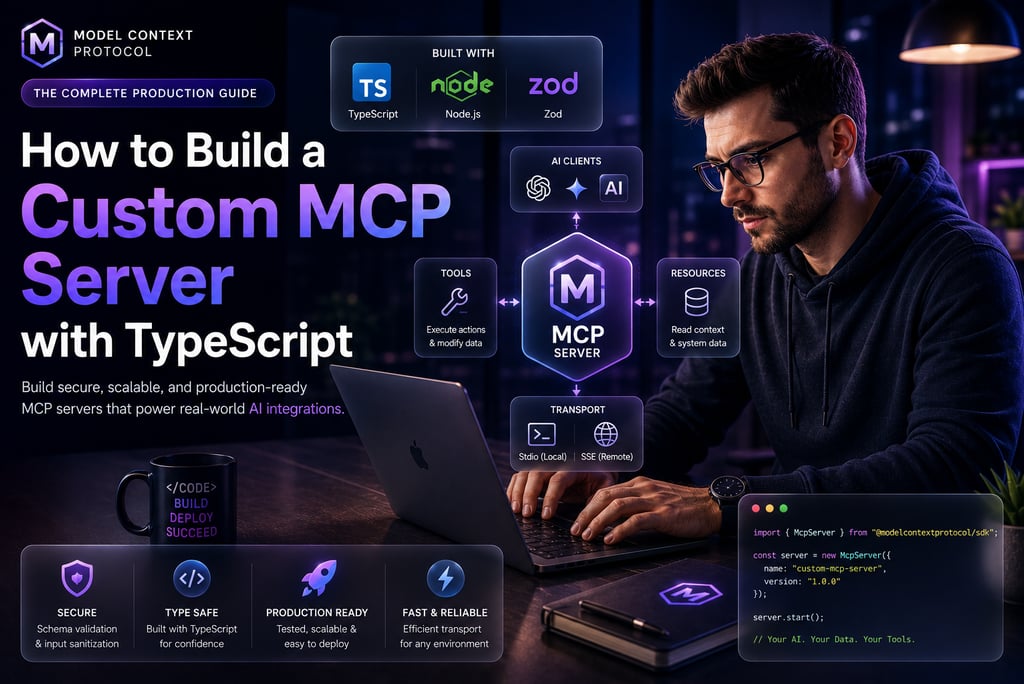
The transition from standalone large language models to autonomous, tool-augmented agents is the defining shift in modern business automation. For engineering teams and software operators, however, this transition has historically been bottlenecked by integration debt. Connecting an AI model to an internal customer relationship management (CRM) database, an inventory system, or a proprietary API required building custom, brittle code adapters for every unique model variant.
The Model Context Protocol (MCP), introduced as an open-source standard, completely dismantles this siloed approach.
MCP acts as a universal communication standard for AI capabilities. By decoupling the core language model layer from underlying application data services, it allows technical teams to build secure, modular capabilities once and instantly surface them to any compliant host application—including Claude Desktop, Cursor, and enterprise developer environments. This comprehensive blueprint details how to engineer a production-grade, highly secure MCP server from scratch using Node.js and TypeScript.
The Problem: The Fragility of Bespoke Function Calling
What critical system vulnerabilities do custom function-calling setups present? Bespoke AI function calling forces developers to maintain unique, hand-rolled API endpoints and prompt schemas for different model versions. This lack of standardization introduces severe engineering overhead, security risks from unvalidated parameters, and vendor lock-in. MCP solves this by enforcing a uniform JSON-RPC 2.0 interface.
Before the introduction of open connection protocols, developers relied on vendor-specific function-calling definitions. This fragmentation hurts scaling infrastructure in three ways:
Compounding Engineering Overhead: Engineering hours are constantly wasted updating schema definitions whenever an enterprise shifts its primary model choice from one vendor to another.
Brittle Production Pipelines: Minor runtime updates to external JSON payloads frequently break active multi-agent loops, causing unhandled runtime crashes or infinite loop errors that spike API resource costs.
Data Integrity Vulnerabilities: Custom integration code often lacks rigorous data validation layers. Without strict type checks, systems remain highly susceptible to malicious prompt injections that can trick backend APIs into running unintended database mutations.
Standardizing your AI data infrastructure around the Model Context Protocol isolates your core codebases from changes in the model landscape, guaranteeing that your application tools remain operational across different model generations.
The Architectural Framework: Host, Client, and Server
What are the foundational architectural components of the Model Context Protocol? The protocol operates on a clean, asymmetric architecture consisting of three core primitives: the Host, the Client, and the Server. The Host is the master environment application. The Client handles session initialization, while the Server exposes executable Tools, read-only Resources, and Prompts.
To build a secure and highly performant integration layer, technical leads must understand the specific responsibilities of each architectural component:
The Host: The primary application interface (such as Claude Desktop or a specialized developer IDE) where the user interacts with the model. The host is responsible for managing user permissions, managing client lifecycle states, and enforcing final authorization parameters.
The Client: An internal connection engine running within the host application. The client handles protocol handshakes, enforces communication safety limits, and translates raw model function calls into structural JSON-RPC 2.0 messages.
The Server: Your custom-built background application. The server remains decoupled from the host, running as a localized background process or a cloud container. It maps internal corporate databases and internal API services into clean, standardized protocol schemas.
When designing an automated AI integration layer, architects must cleanly separate their capabilities:
When to Deploy an MCP Tool: Use tools when the AI model needs to modify system states, call external REST endpoints, run a mathematical script, or write new entries into a production database.
When to Deploy an MCP Resource: Use resources when you need to pass raw company policies, real-time system server logs, schema shapes, or static product documentation files directly into the active prompt workspace.
Infrastructure Costs and Financial Realities
What are the financial implications of deploying local versus remote MCP server topologies? Local stdio transport servers run directly on end-user workstations as native background processes, incurring zero external cloud hosting fees. Remote SSE configurations require persistent, cloud-hosted container environments, introducing recurring compute, networking, and data egress bills.
To accurately budget for your integration architecture, consider the primary cost vectors associated with running custom servers:
Workstation Resource Consumption: Local background worker processes utilize existing on-premise hardware resources. For internal teams or individual developers, this approach keeps ongoing maintenance costs near zero.
Cloud Production Container Costs: Deploying scalable, multi-tenant network interfaces requires using container platforms like AWS ECS, Google Cloud Run, or Azure Container Instances. These environments introduce ongoing bills for memory allocations, connection management, and network transfer charges.
Security, Risks, and Compliance Strategies
How do engineering teams safeguard custom MCP servers from prompt injection vectors? Securing custom servers requires implementing schema parameter boundaries using Zod, deploying least-privilege API database keys, separating high-risk runtime variables from codebase commits, and requiring manual human confirmation loops before executing destructive mutations.
Building deep integrations between AI models and internal systems introduces unique security risks:
Mitigating Prompt Injection Vulnerabilities: If an AI agent reads untrusted text from an external file or a website, that text could contain hidden commands designed to hijack your tools. If the agent drops that data directly into a tool parameter without verification, it can trigger unauthorized API modifications.
Enforcing Schema Boundaries: Always configure your tools with explicit input schemas using Zod. Enforcing strict parameter types and blocking unknown fields prevents the model from injecting unintended arguments into your backend scripts.
Enforcing Human-in-the-Loop Safeguards: Never give an autonomous agent the ability to process financial transactions, drop database tables, or send out customer-facing mass emails completely on its own. Always build a user confirmation screen that requires manual approval before executing high-risk, irreversible operations.
Return on Investment (ROI) and Business Impact
What quantitative business value does standardizing on the Model Context Protocol deliver? Transitioning to unified MCP endpoints reduces custom API integration debt by up to 65%. It eliminates the need to maintain multiple legacy connection libraries, simplifies software development cycles, and allows companies to instantly swap underlying AI models without rewriting their core tool codebases.
Strategic Infrastructure Assessment
By adopting a universal connection layer, businesses can future-proof their software development. Instead of getting locked into a single AI provider's custom feature set, engineering teams can swap their underlying model models in minutes. This decoupled setup lets you easily select and deploy the most cost-effective model options for your unique operational workflows as the industry evolves.
Future Outlook: The Evolution of Agentic Connectivity
What core advancements define the long-term technology roadmap for the protocol? The 2026-2028 protocol roadmap includes stateless communication alternatives, shared protocol registries, and agent-to-agent negotiation layers. These advancements allow distributed software tools to automatically discover, test, and use capabilities across global business networks.
As enterprise automation infrastructure scales up, your custom tools will need to safely interact with other automated tools across company boundaries. Standardizing your current software development around the open Model Context Protocol ensures your business platforms stay fully compatible with the next wave of autonomous web infrastructure.
Conclusion
Building a custom MCP server with TypeScript provides a clean, reliable framework for connecting your proprietary data services to the world's most powerful language models. By replacing old, brittle script adapters with type-safe schemas and standardized JSON-RPC communication channels, your engineering team creates durable integration assets that stand the test of time. Take control of your automated infrastructure: select a core database, deploy the official TypeScript SDK, and configure your very first custom server today.
FEATURED SNIPPET ENGINEERING
40-Word Snippet
To build a custom MCP server in TypeScript, initialize a Node project supporting ES Modules, install @modelcontextprotocol/sdk and zod, initialize the server instance using the McpServer class, register your tools with clear Zod definitions, and connect using standard StdioServerTransport streams.
60-Word Snippet
Building an enterprise-grade custom MCP server requires instantiating the core McpServer class from the official TypeScript library. By using modern server.registerTool() patterns alongside Zod parameters, developers create secure, verified action paths that language models can easily parse. The final application process is launched as a localized background worker utilizing safe stdio communication or network-ready SSE transport connections.
Numbered List Snippet
Initialize Project: Scaffold a Node.js project directory and enable ES Module execution.
Install Libraries: Run npm install @modelcontextprotocol/sdk zod to add your foundational development dependencies.
Configure TypeScript: Configure tsconfig.json to enforce strict type checking and output clean NodeNext JavaScript files.
Instantiate McpServer: Write code using the modern new McpServer() initialization constructor.
Register Core Tools: Build custom functions using server.registerTool() and secure Zod schema validation rules.
Deploy Communication Transport: Bind your application process to an active StdioServerTransport channel for local execution.
TARGET AUDIENCE SEGMENTATION
Best For:
SaaS Product Engineers: Developers looking to build long-term, cross-platform tool connections without getting locked into a single AI provider's ecosystem.
Enterprise Tech Leaders: Executives aiming to standardize data access layers across internal engineering teams while maintaining strict security controls.
AI Startup Builders: Product teams seeking to quickly add real-world capabilities to their applications using stable, open-source protocol code.
Not Ideal For:
Non-Technical Marketers: Users looking for ready-to-use SaaS integrations who don't want to handle code deployments or work with command-line interfaces.
Static Site Operators: Businesses running basic websites that don't use dynamic AI workflows or connect to internal database systems.
STRATEGIC MONETIZATION MAP
In-Content Affiliate Opportunities: Insert contextual, trackable referral links within the workspace initialization steps to guide developers toward high-performance virtual machine platforms, cloud database services, and error-monitoring systems.
Lead Magnet Call-To-Action: Promote the HostifyAI Production MCP Boilerplate Package directly after the initial project setup sections to capture qualified developer email addresses.
Enterprise Outreach Strategy: Include a targeted banner midway through the technical implementation section offering specialized corporate consulting services for designing complex multi-agent database systems.
HostifyAi
Helping you discover the best AI tools, grow your online business, and make smarter digital decisions.
Contact
© 2025. All rights reserved.