Table of Contents
ToggleINTRODUCTION
Hiring and managing employees in the United States has become much more complex. Companies are expected to hire faster, improve candidate experience, manage remote teams, reduce bias, and stay compliant with labor laws—all at the same time. Doing this manually is becoming harder every year.
From my experience, even small delays in screening resumes or scheduling interviews can lead to losing good candidates or overloading HR teams. Companies that started using AI in hiring were able to speed up shortlisting, reduce repetitive work, and focus more on people instead of paperwork.
This is why AI in hiring and HR is no longer experimental. By 2026, US companies are not asking whether to use AI, but how to use it responsibly. In this blog, you’ll understand where AI truly helps in hiring and HR, where it doesn’t, and what businesses should realistically expect in the coming years.
Why This Topic Matters Today

The US job market is highly competitive and keeps changing fast. A single job post can receive hundreds or even thousands of applications within a short time, which puts heavy pressure on HR teams.
Today, HR teams are dealing with challenges like:
High application volumes that are hard to review manually
Skills gaps across key industries
Managing remote and hybrid teams
Higher scrutiny around fairness and compliance
According to the LinkedIn Workplace Learning Report (2024), more than 65% of HR leaders say automation is now essential for modern hiring and workforce development.
As companies move toward 2026, AI is no longer a luxury for HR teams. It is becoming a necessity to manage scale, speed, and compliance effectively.
Background: How Hiring and HR Worked Traditionally

Before AI adoption, most HR operations were manual and very time-consuming. Traditional hiring processes usually involved:
Recruiters manually reviewing resumes
Interview scheduling through phone calls or emails
Using paper documents or spreadsheets to manage records
Making screening decisions that were often subjective
These methods worked when teams were small, but problems started as companies grew. Hiring cycles became slower, recruiter burnout increased, and inconsistency in decisions became common.
Manual systems also made it difficult to spot patterns, measure hiring performance, or plan workforce needs in a structured way. This lack of visibility limited how effectively HR teams could scale.
How It Works Today (Modern Approach)
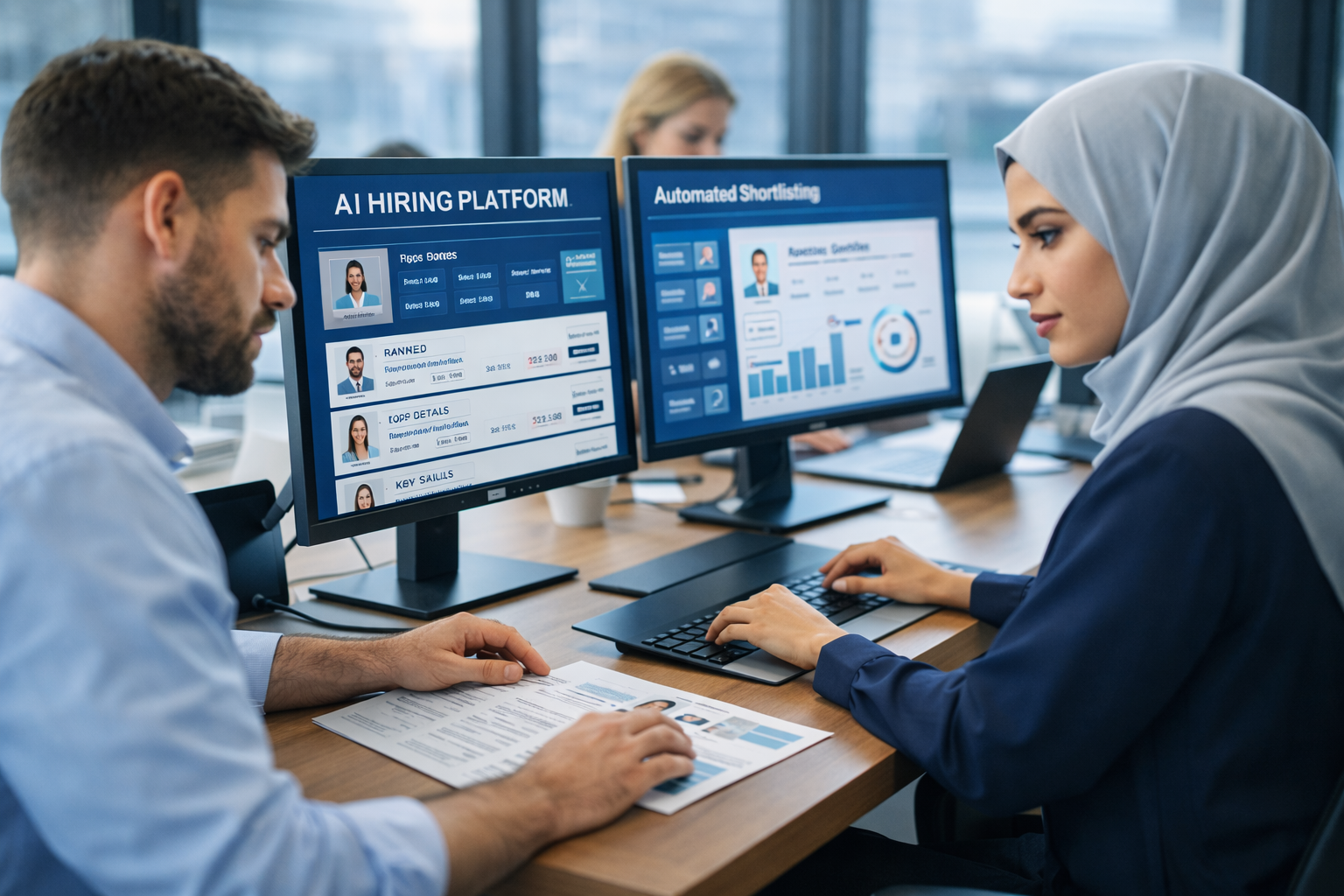
Modern AI in hiring and HR is mainly used for task automation and decision support, not for replacing people. These systems help HR teams handle work more efficiently while keeping human control intact.
Today, AI helps HR teams to:
Process large volumes of applications in less time
Match skills more objectively based on job requirements
Automate interview scheduling and documentation
Analyze workforce and hiring trends for better planning
What matters most is that final hiring decisions are still made by humans.
Editorial note:
The most effective HR teams use AI to reduce noise and repetitive work, not to remove responsibility or accountability from decision-making.
Key Processes Where AI Is Used

1. Resume Screening and Shortlisting -
AI tools scan resumes to:
Match skills to job requirements
Rank candidates consistently
Reduce manual screening time
2. Candidate Communication -
AI chatbots handle:
Application status updates
Interview reminders
Basic candidate questions
3. Interview Scheduling -
Automation tools:
Sync calendars
Reduce scheduling delays
Lower interview no-show rates
4. Onboarding and Documentation -
AI assists with:
Form verification
Policy acknowledgments
Training assignments
5. Workforce Analytics -
AI analyzes patterns related to:
Engagement
Attrition risk
Performance trends
Tools, Methods, and Technologies Involved

Behind AI-driven hiring and HR systems are a few core technologies working together:
Natural Language Processing (NLP) – Helps read and understand resumes, applications, and feedback
Machine Learning – Improves matching and recommendations over time based on outcomes
Predictive Analytics – Forecasts hiring needs, attrition risk, and workforce gaps
Workflow Automation – Connects different HR tools and automates routine tasks
For most US companies, access to these technologies comes through AI-enabled Applicant Tracking Systems (ATS). These platforms allow HR teams to use AI without building complex systems from scratch.
Real-World Examples and Use Cases

Google applies structured, data-driven hiring assessments to reduce interviewer bias (Google re:Work, 2023).
Amazon uses AI-driven automation to manage high-volume seasonal hiring efficiently.
IBM uses AI to support internal talent mobility and skills-based role matching.
Mid-size US companies use similar tools to compete with larger employers without expanding HR headcount.
Benefits for Businesses and HR Teams
Using AI in hiring and HR brings several clear advantages:
Faster hiring cycles with less manual delay
Lower administrative workload for HR teams
More consistent screening across candidates
Better candidate experience through quicker responses
Data-backed workforce planning instead of guesswork
According to McKinsey Global Institute (2023), responsible HR automation can reduce operational HR costs by up to 30%, while improving efficiency and decision quality.
Risks, Challenges, and Limitations
AI adoption in hiring and HR is not risk-free, and businesses need to be aware of the challenges. Common issues include:
Bias in historical data, which can affect recommendations
Over-reliance on automated scores without human review
Limited transparency in how some AI systems make decisions
Integration challenges with older or legacy HR systems
Expert insight:
AI should support HR teams by reducing workload and improving consistency, but it should never replace human judgment or legal responsibility. Final decisions must always remain with people.
Ethical, Legal, and Practical Considerations
US companies using AI in hiring must comply with:
Equal Employment Opportunity (EEO) laws
Data privacy requirements
Transparency standards in hiring decisions
The U.S. Equal Employment Opportunity Commission (EEOC, 2023) has clearly stated that AI-driven hiring systems must not create indirect or unintended discrimination. Responsibility still lies with the employer, not the software.
Best practices for responsible AI use in hiring include:
Regular bias audits to detect unfair patterns
Human-in-the-loop review for final decisions
Clear documentation explaining how and where AI is used
Small businesses can adopt AI in hiring gradually, without taking big risks:
Start with an AI-enabled ATS instead of building new systems
Automate interview scheduling first to save time quickly
Introduce resume screening later, once teams are comfortable
Always review AI recommendations manually before making decisions
Low-risk automation delivers value the fastest and helps teams build confidence before expanding AI usage further.
Future Trends and Outlook (2026+)
Looking ahead to 2026 and beyond:
Skills-based hiring will replace degree-based screening in many roles
AI governance rules will become stricter and more clearly enforced
Workforce planning will shift from reactive to predictive models
HR roles will move more toward strategy, culture, and people development
AI in HR will evolve from basic automation to deeper insight and decision support
These changes will push HR teams to think less about processes and more about long-term workforce strategy.
Frequently Asked Questions (FAQs)
What is AI in Hiring and HR?
AI tools that automate and support recruitment, onboarding, and workforce management tasks.
Does AI replace HR professionals?
No. AI supports HR teams by handling repetitive tasks while humans make final decisions.
Is AI hiring legal in the US?
Yes, when systems comply with labor, privacy, and anti-discrimination laws.
Can small businesses use AI HR tools?
Yes. Many platforms are affordable and scalable.
How can companies reduce bias in AI hiring?
By auditing data, involving humans, and testing systems regularly.
Conclusion
AI in hiring and HR is not about removing people from HR.
It is about removing friction from HR processes.
Practical action steps:
Identify repetitive HR tasks that slow teams down
Introduce AI only where transparency and fairness can be maintained
Keep humans involved in final decisions
When used wisely, AI allows HR teams to spend less time on paperwork and more time focusing on people, culture, and long-term workforce growth.